
Last updated September 20, 2026
Free on-site gate assessment - hinges, posts, and your LiftMaster or Nice gate operator checked before anything is quoted
The assessment is free and the quote is the invoice.
Farm & ranch
 Before
 After
After Before
 After
After Before
 After
AfterDIY vs Professional Gate Repair: The West Covina Homeowner’s Decision Guide
Most gate repair advice on the internet starts from a broken premise. It asks whether you’re “handy” or “not handy,” then divides the world accordingly. But handiness is not the variable that matters. Liability is. A homeowner who adjusts their own limit switches and documents the before-and-after readings has done something more useful than a technician who adjusted them verbally and left no record. But a homeowner who replaces an operator’s control board without disconnecting entrapment sensors has created a UL 325 liability that the next owner inherits. This guide, written from the ground in West Covina, draws the line by task, not by personality. You’ll learn which specific gate repairs California law allows you to do yourself, which ones void your warranty the moment you touch them, which ones require a licensed contractor, and which ones require a permit pulled from the City of West Covina.
Quick Answer
For most West Covina homeowners, the right split is this: mechanical and cosmetic tasks like hinge lubrication, bolt tightening, wheel cleaning, and track clearing are reasonable DIY territory if documented. Electrical and operator-level work, especially anything involving the UL 325 entrapment sensors, control board, or motor wiring, should go to a licensed gate professional offering our Gate Repair services, because a mistake there creates a safety liability and a code violation, not just a broken gate. In practice, that means roughly 20 percent of gate repairs are safe for a careful homeowner and 80 percent carry enough legal or warranty consequence to justify a pro.
Table of Contents
- What California Law Actually Says About Gate Repair
- The Task-by-Task Matrix: 15 Common Gate Repairs Classified
- Entrapment Sensors: The One System Where DIY Carries Real Liability
- Three DIY Repairs That Backfire in West Covina’s Soil and Climate
- What a DIY Repair Needs to Be Useful to the Next Professional
- The Three-System Decision Framework
- Warranty Implications: What the Fine Print Actually Means
- Common Mistakes to Avoid
- When to Call a Professional
- Frequently Asked Questions
- The Bottom Line
BeforeAfterWhat California Law Actually Says About Gate Repair
California regulates gate work through two overlapping frameworks: contractor licensing law and the state’s automatic gate safety standards, which incorporate UL 325. Here is the short version. Any work valued at $500 or more in labor and materials falls under the California Contractors State License Board’s jurisdiction. That means the person doing it needs a C-61/D-28 (gates and automation) or a relevant specialty license, unless the work is genuinely incidental handyman work under the $500 threshold. Most operator replacements in West Covina run $800 to $2,400, so they sit squarely inside licensed-contractor territory. The second framework is safety law. California has required automatic gates to meet specific entrapment protection standards since the early 2000s, and any modification to an operator or its safety devices must leave the gate compliant with the standard it was installed under. This is not a county-by-county patchwork. It applies in West Covina the same way it applies in Pasadena or Anaheim.
What this means in practice: a homeowner may legally lubricate hinges, tighten bolts, clear debris from a track, replace a battery in a keypad, or re-aim a photo-eye. Once you remove the operator cover and begin altering motor wiring, travel settings that affect closing force, or the control board’s safety inputs, you are modifying a safety system. At that point, the legal exposure shifts. If the gate later closes on someone, the question investigators ask is who last modified the safety circuit. If the answer is an unlicensed homeowner without documented before-and-after readings, that homeowner is in a difficult position.
The City of West Covina also requires permits for certain gate installations and structural changes, particularly anything involving new footings, piers, or modifications to the driveway approach. A repair that is purely mechanical, like replacing a wheel or adjusting a hinge, does not trigger permit review. A new gate that requires pouring concrete for a post does. We have helped homeowners in neighborhoods from South Hills to Woodside understand which side of that line their project falls on, and the answer usually comes down to whether concrete is being poured.
The Task-by-Task Matrix: 15 Common Gate Repairs Classified
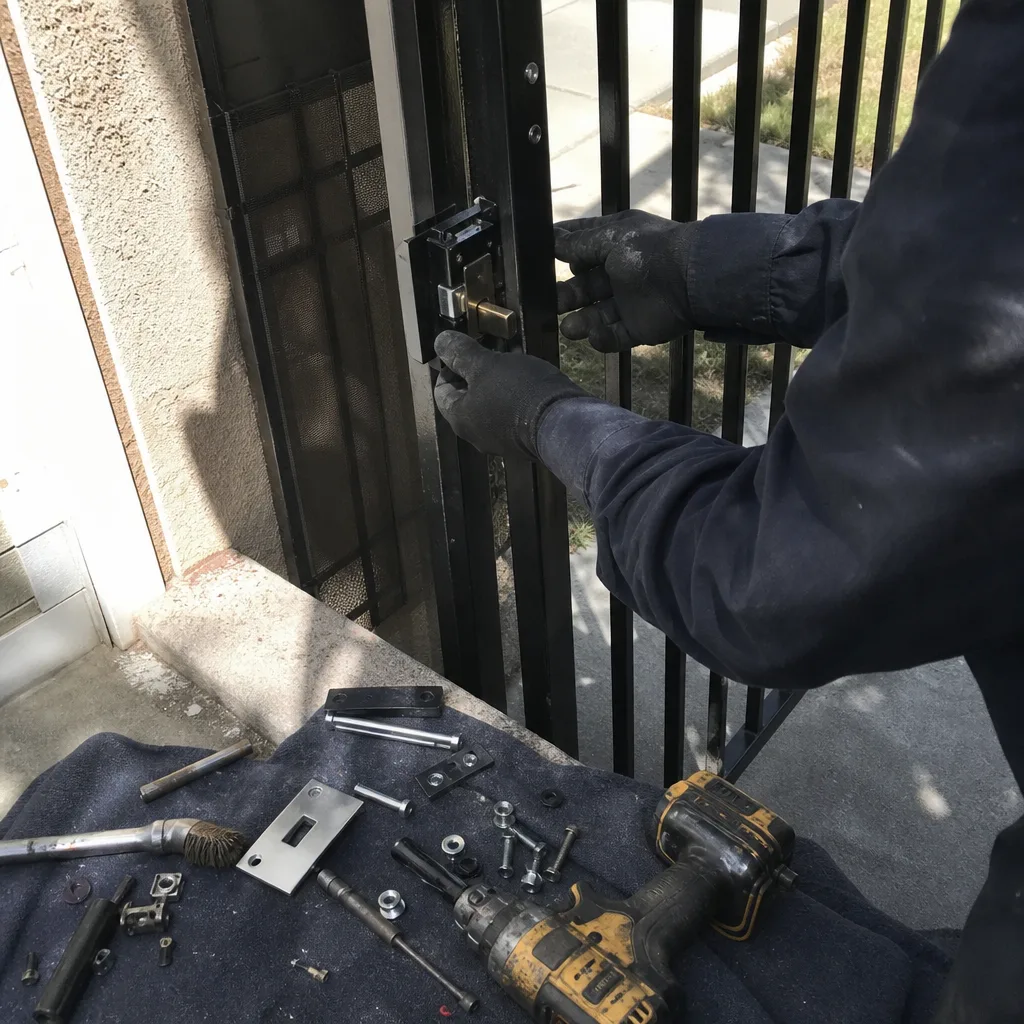
Here is the matrix. It covers the fifteen gate repair tasks we see most often in West Covina, categorized by what California allows, what your warranty allows, and what common sense allows. Use this as a reference, not a manual.
- Lubricating hinges and rollers: Legal to DIY. No warranty impact. Keep a record of the lubricant used. Some operators, especially older DoorKing units, have lubricated gearboxes that are factory-sealed, and adding the wrong grease can damage the gear set.
- Tightening loose bolts and bracket hardware: Legal to DIY. No warranty impact. Use a torque wrench if you have one, and photograph the before state. A bracket that was loose for months often has wallowed-out holes that need a plate welded in, which is no longer a bolt-tightening job.
- Clearing debris from a slide track: Legal to DIY. No warranty impact. In West Covina, where decomposed granite and eucalyptus debris accumulate fast, this is the single highest-value maintenance task a homeowner can do.
- Replacing keypad or remote batteries: Legal to DIY. No warranty impact. Document the battery type and date. Most keypads take a 9V; most remotes take a CR2032 or A23.
- Re-aiming a misaligned photo-eye: Legal to DIY. No warranty impact, provided the beam is restored to its specified alignment. Photograph the lens positions before and after. A photo-eye that is roughly two inches out of alignment on a sunny West Covina afternoon will often test fine in the shade and fail at noon.
- Replacing a broken wheel or roller: Legal to DIY under the $500 threshold, provided the wheel is a drop-in replacement. Some newer Elite and LiftMaster slide gates use captured roller assemblies that require partial rail disassembly, and that pushes the job firmly into professional territory.
- Replacing a gate leaf hinge: Legal to DIY if the gate is a light aluminum single-leaf. No permit needed. But if the gate is iron and weighs more than 400 pounds, the hinge replacement needs to be done with the leaf properly supported, and a mistake can drop the leaf on a person or a vehicle. We classify heavy iron hinge work as professional work, not because the law requires it, but because the consequence of failure is a crushed foot.
- Adjusting travel limits on a swing or slide operator: Legal to DIY, but this is the first task on the list that alters the operator’s safety envelope. If the force settings are left too high after a limit adjustment, the gate will travel until it meets resistance, and that resistance may be a person. Document the original limit positions, the new positions, and test with the entrapment sensors connected. This is the most common DIY adjustment we see go wrong in West Covina, usually on Mighty Mule and Ghost Controls units installed by previous homeowners.
- Replacing a capacitor or start relay: Legal to DIY if you are replacing an identical part with the power disconnected. Warranty impact: likely voided on the operator if it is still in its coverage period. This is the first task on the matrix that will probably void a manufacturer warranty, because it requires opening the operator housing and confirming the work with a meter.
- Replacing a control board: Requires a licensed contractor in California when the job value exceeds $500, which most board replacements do once labor is counted. Warranty impact: voided if done outside an authorized channel. Safety impact: high, because the board contains the entrapment protection logic, and the new board must be configured to the specific gate’s weight, travel, and sensor layout. This is one of the repairs where a DIY attempt most often creates the liability we described in the opening.
- Replacing a swing or slide operator motor: Requires a licensed contractor in California for most residential installations. Warranty impact: voided if the motor is still under coverage. Permit impact: generally no permit, but the UL 325 compliance burden transfers to whoever does the work. We service all nine major brands, including LiftMaster and DoorKing, and the most common failure we see in West Covina is not the motor itself but the limit switch wiring that the previous installer left exposed to sprinkler overspray.
- Rewiring a gate operator or adding a new circuit from the panel: Requires a licensed contractor. This is electrical work under the California Electrical Code, full stop. If the circuit is being extended from the main panel, a permit from the City of West Covina is required. Do not open the panel. Do not add a breaker. This is where the $500 threshold almost always kicks in, and where the fire risk is real.
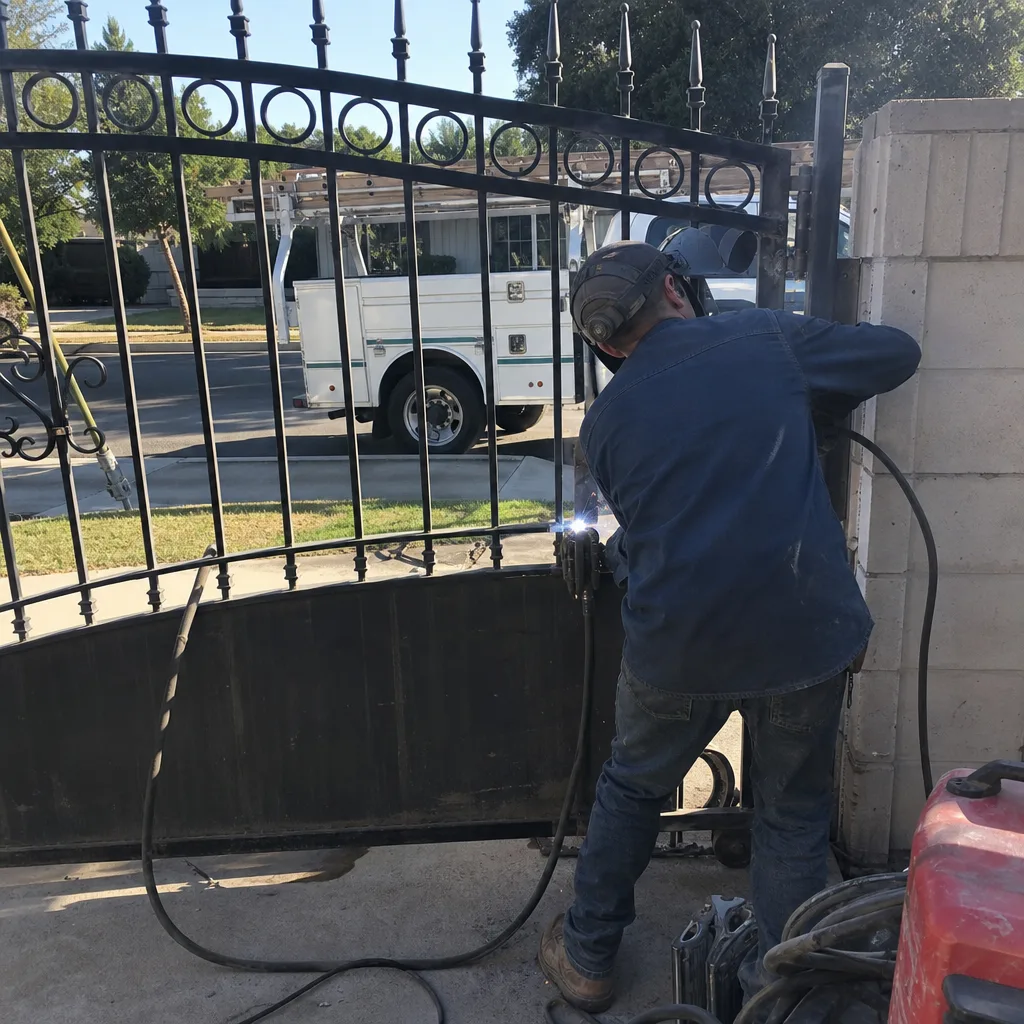
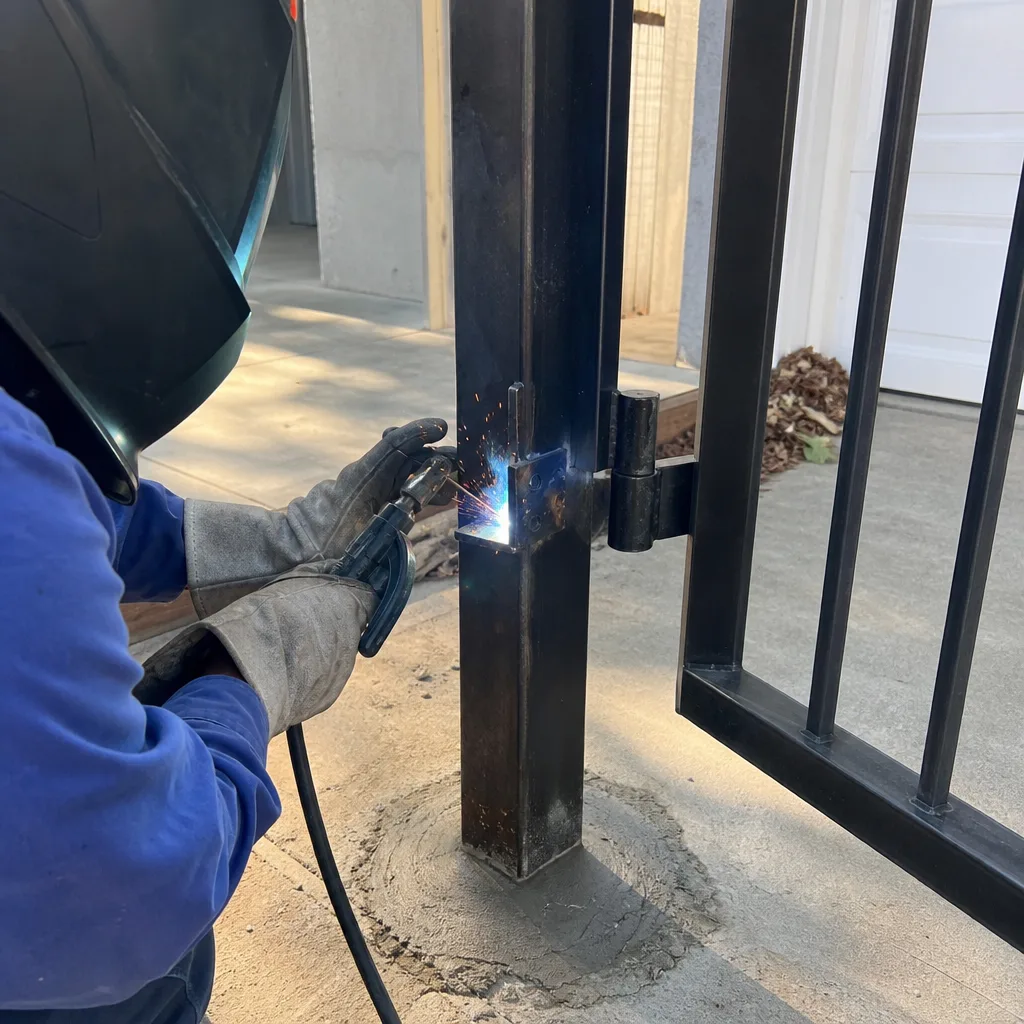
- Welding a broken gate hinge or crack: Requires a welder with the right setup. The legal threshold depends on the job value, but the practical threshold is that a bad weld on a 600-pound iron gate fails catastrophically. In West Covina’s marine-influenced air, especially in neighborhoods closer to the 10 freeway, untreated welds rust through within two years. This is professional work.
- Pouring a new pier or footing for a gate post: Requires a permit from the City of West Covina and a licensed contractor for the concrete work. This is structural. The gate post is a cantilever holding a moving load. A homeowner-poured pier that is 4 inches too shallow or poured without rebar will lean within a season and take the gate out of alignment.
- Installing entrapment protection devices: Requires a licensed contractor. This is the safety-critical task on the list. An entrapment sensor that is installed incorrectly can fail to stop the gate during a closure event, and that failure has a body count attached to it. This is not the place to learn.
Entrapment Sensors: The One System Where DIY Carries Real Liability
Every automatic gate in West Covina is required to include entrapment protection. That protection takes two forms. The primary device is the inherent entrapment sensor, which monitors the motor’s current draw and reverses the gate when it meets unexpected resistance. The secondary device is the external sensor, usually a photo-eye or an edge sensor, which detects an obstruction before the gate touches it. UL 325 requires both layers to be present and functional on any automatic gate installed or modified after the standard took effect.
Why this matters for the DIY question: when you adjust a limit switch, you change where the gate stops. When you adjust the force setting, you change how hard it pushes before reversing. When you replace a control board, you reinitialize the logic that ties all of it together. Each of those adjustments is invisible once the cover is back on. The gate may open and close perfectly in testing, and still be non-compliant because the force threshold is set too high or the photo-eye is wired to the wrong input. The first person to discover the mistake is the one the gate hits.
We have seen the aftermath of this in West Covina. A homeowner on the south side of Cameron Park replaced a control board on a slide operator, wired the photo-eye to the auxiliary output instead of the safety input, and the gate functioned for six months before a neighbor’s child triggered a closure event. The gate reversed only because the inherent sensor caught it. The board replacement saved approximately $400. The liability exposure, had the inherent sensor also been misconfigured, would have been six figures. That is the real cost equation in entrapment work. The savings sit on one side of the ledger, and a life-altering liability sits on the other.
There is no version of this guide that recommends homeowner-level work on entrapment devices. The law in California treats operator-level modifications as safety system modifications, and the next owner of your home inherits whatever you left inside that operator housing. When we replace a board or rewire an entrapment loop, we photograph the wiring before and after, record the force readings, and leave a written record. That documentation is part of gate motor and opener service in West Covina, and it should be part of any professional repair you pay for.
Three DIY Repairs That Backfire in West Covina’s Soil and Climate
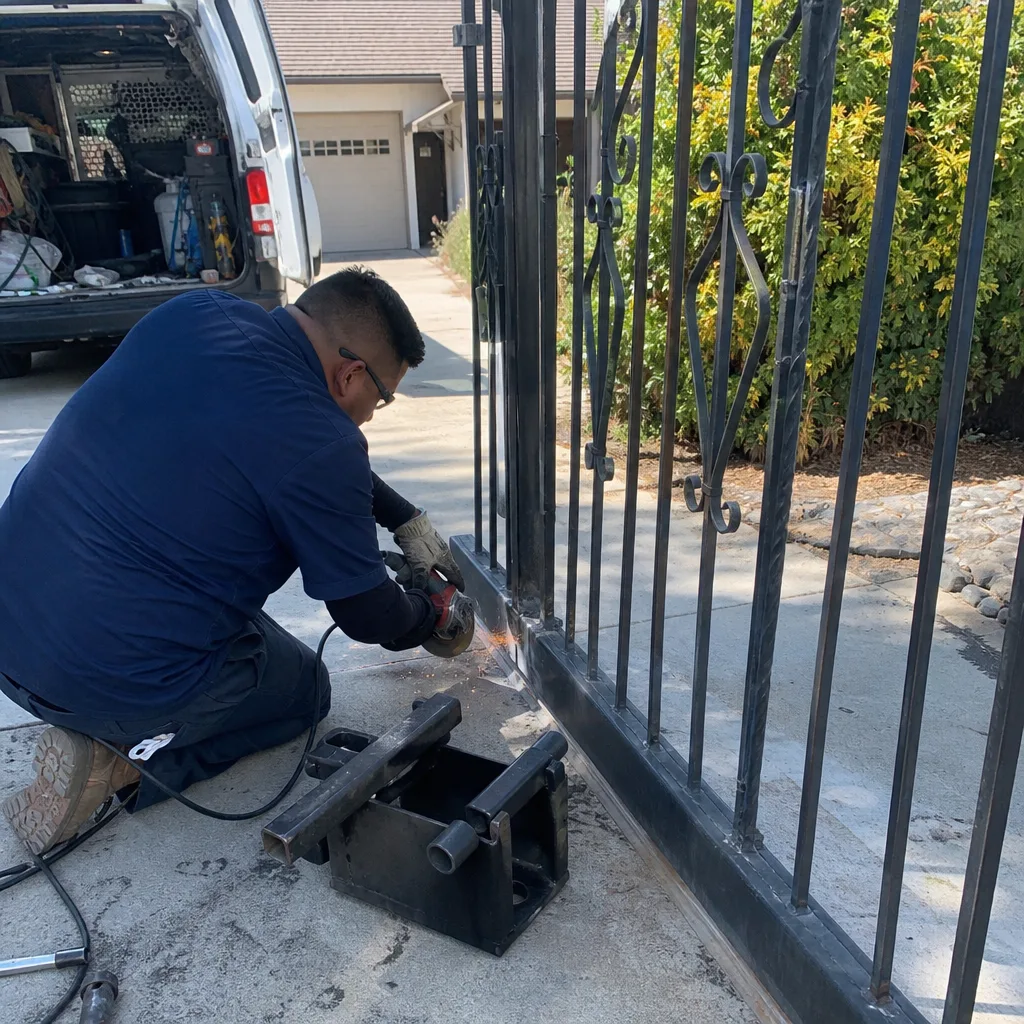
West Covina has a specific environmental profile: decomposed granite foothill soil on the north side, heavier clay in the flatlands, hard water, high UV exposure, and a dry season that bakes exposed metal and plastic for eight months of the year. Certain gate repairs that look simple in a YouTube video fail differently here. These are the three we see most often.
1. The post that was “straightened” instead of re-poured. A leaning gate post in West Covina is usually a footing problem, not a bolt problem. Homeowners often dig around the post, pour a bag of quick-set around it, and call it fixed. The post stays straight for one season. Then the clay soil expands in the first winter rain, the quick-set cracks, and the post leans again, now with a collar of broken concrete that makes the eventual re-pour more expensive. The fix is a proper pier, usually 36 to 42 inches deep with rebar, poured with a permit. That is a gate installation in West Covina task, not a weekend repair.
2. The hinge that was lubricated instead of replaced. West Covina’s UV load embrittles gate hinge bushings within five to seven years. The gate starts grinding, so the homeowner lubricates it. The grinding goes away for a week. Then it returns louder, because the bushing is now fully cracked and the metal is wearing metal. By the time we see it, the hinge itself is often ovaled out and the repair has doubled from a $90 bushing replacement to a $290 hinge plate replacement. If the gate grinds, lubrication is a diagnostic step, not a repair. The bolt pattern and the wear pattern will tell you which one you have.
3. The operator that was “just fine” after a sprinkler spray. Sprinkler overspray against an operator housing is common across West Covina, especially on properties with automatic irrigation near the driveway. The operator still runs, so the homeowner dries the outside and moves on. Inside, the moisture is wicking into the wire terminals and starting electrolysis. Six months later, the limit switch reads erratically and the gate reverses mid-cycle. The DIY-visible part of this repair is nothing; the actual repair is opening the housing, cleaning the terminals, tinning the corroded leads, and relocating the sprinkler head. In our experience, most gate repair in West Covina calls that start with “intermittent” end with a sprinkler head relocation.
What a DIY Repair Needs to Be Useful to the Next Professional
Most DIY gate repairs fail the future-usefulness test. A homeowner tightens a bolt, swaps a battery, or re-aims a photo-eye, and when a professional arrives two years later, there is no record of what was touched. The professional starts from zero, often re-diagnosing a problem that was already found and fixed once. That is the billable inefficiency this guide exists to prevent.
Here is the documentation standard we use on every commercial and residential job, and it is the same standard a careful homeowner can apply to DIY work. Under Clause 4 of the Haven Standard, evidence goes on every job, at no additional charge. For a homeowner, the equivalent is a phone camera and a notes app.
- Photograph the before state. Wide shot, then close-up. The wide shot shows context, the close-up shows the specific bolt, wire, or setting. Do this before touching anything.
- Record the part number or specification. If you replace a battery, write down the type. If you replace a wheel, write down the diameter and the axle spec. If you adjust a limit switch, write down the original position and the new position. A technician who knows the limit switch was moved from 10 to 12 degrees does not have to re-derive the setup.
- Photograph the after state from the same angle. The pair of images is the evidence. It converts an assertion into a record.
- Test the gate through a full open and close cycle with the sensors connected. Record whether it reversed properly, hesitated, or made an unusual noise. Note the date and the approximate temperature.
- Store the record where the next owner can find it. A folder in the garage, a note taped inside the operator housing, or a file attached to the home’s maintenance log. The record is only useful if it survives the sale of the house.
This standard is the difference between a repair that compounds and a repair that carries forward. When we leave a job in West Covina, the homeowner gets a photo log of every adjustment, a written record of the part number installed, and the readings we set. That is not a luxury. It is the reason the next repair costs less.
The Three-System Decision Framework
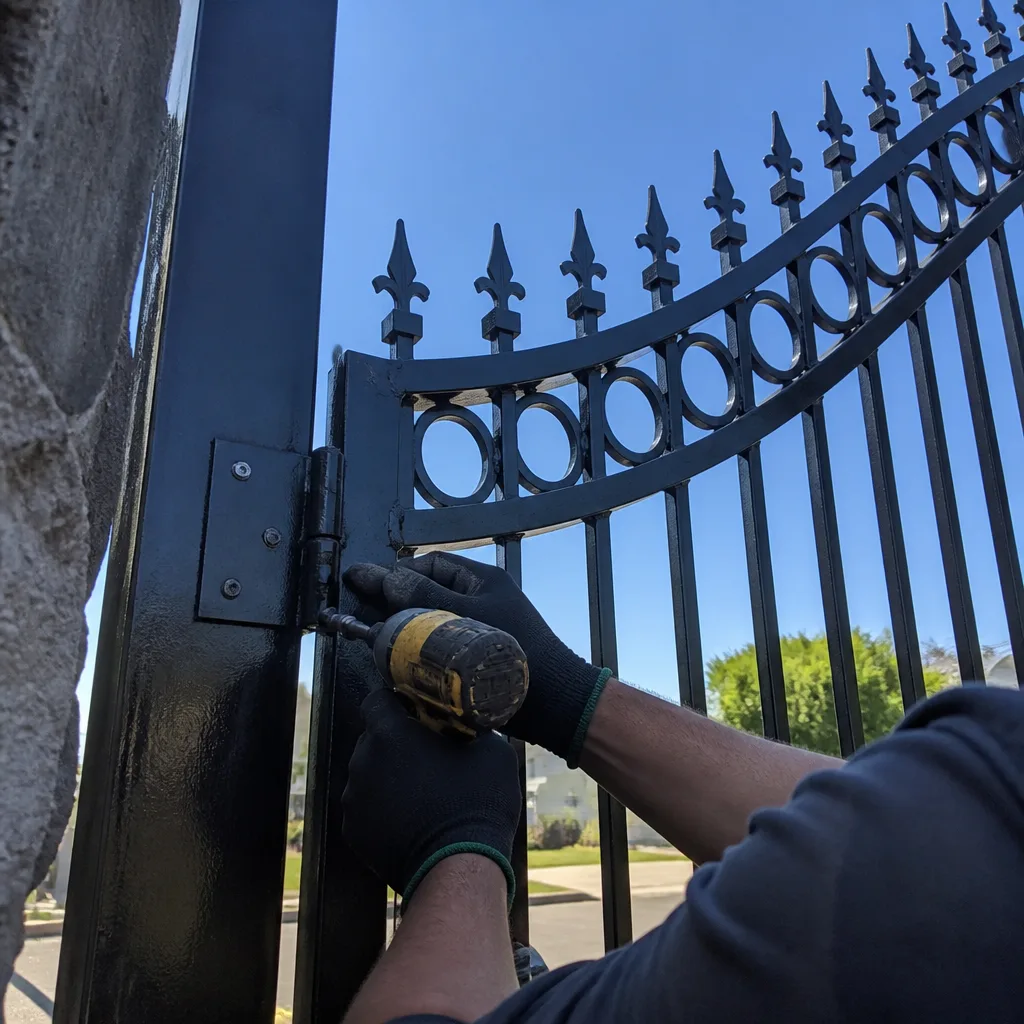
If you want a decision rule that holds up across every gate repair scenario, here it is. A gate has three systems: the mechanical system, the electrical system, and the safety system. Your decision about DIY hinges on which system the repair touches.
If the repair affects only the mechanical system (hinges, wheels, track, bolts, lubrication, post caps), a documented DIY is reasonable. The consequence of failure is a gate that does not open, which is an inconvenience, not a hazard. The $500 threshold and warranty concerns are manageable. Document what you did.
If the repair affects the electrical system (motor, control board, wiring, transformer, capacitor), call a professional. The consequence of failure is a gate that behaves unpredictably, and an unpredictable gate is a safety incident waiting to happen. The warranty is likely voided the moment the housing is opened.
If the repair affects the safety system (entrapment sensors, force settings, photocells, safety edges), always call a professional. No exceptions. The consequence of failure is injury, and the liability attaches to whoever last modified the system.
That is the entire framework. Two systems are often DIY. One is sometimes DIY with documentation. One is never DIY. The complication is that many gate failures present as a mechanical symptom with an electrical cause, or an electrical symptom with a safety cause. A gate that stops mid-cycle in West Covina could be a dirty track, a failing capacitor, or a misaligned photo-eye. The skill that separates a useful DIY repair from an expensive guess is the ability to tell which system you are actually looking at.
Warranty Implications: What the Fine Print Actually Means
Gate operator warranties are not uniform. LiftMaster, DoorKing, Elite, and Mighty Mule each write their warranty language differently, but the structure is consistent. The warranty covers manufacturing defects when the operator is installed by a qualified professional and used under normal conditions. Any modification to the operator’s internal components, including control boards, limit switches, and motor wiring, typically voids the remaining warranty on that component and often on the operator as a whole.
The practical consequence for a West Covina homeowner is this: a $600 operator replacement that fails within the warranty period is a covered replacement if a licensed professional installed it. The same $600 operator that fails after a DIY control board swap is a $600 out-of-pocket replacement plus the cost of the board you already bought. The math on DIY operator work only works if the repair succeeds on the first attempt and never fails within the warranty window. In our experience, that is a less than 50 percent proposition.
There is a second layer. If a homeowner modifies an operator and the operator later causes an injury, the manufacturer’s defense will center on the unauthorized modification. The homeowner’s defense will rest on the documentation they kept. This is why the documentation standard in the previous section matters. It is not just about saving money on the next repair. It is the difference between a liability that lands on you and a liability that lands on the manufacturer.
For homeowners who want to understand where their specific operator falls, the serial number on the housing tells the story. Write it down. Check the warranty status. And if the repair is anything beyond mechanical work, bring that serial number to Vance Gate Repair West Covina home so we can tell you exactly what coverage applies before you spend anything.
Common Mistakes to Avoid
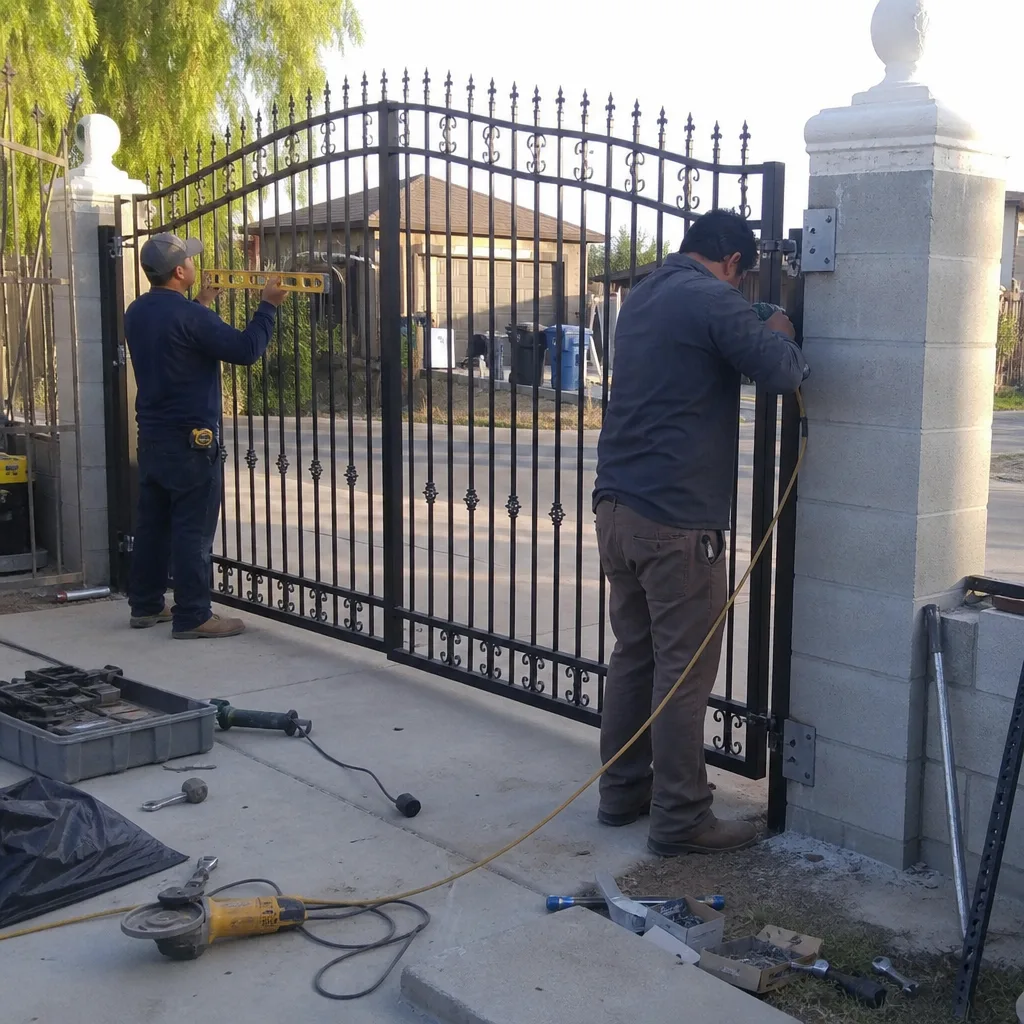
- Adjusting force settings without testing against the entrapment sensors. A force setting left too high converts a slow, safe gate into a crushing hazard. The gate may close fine for months. The failure only shows up when someone is in the path.
- Using the wrong lubricant on a sealed gearbox. Many modern operators use permanently lubricated gearboxes. Adding spray grease to the external surfaces does nothing, and adding it to the internals can break down the factory lubricant. Read the manual before you lubricate anything with a housing.
- Tightening a bracket that is already torn. A bolt that will not hold torque is telling you something: the metal behind it is compromised. Crank it down and you strip the threads. The fix is a welded plate or a re-drill, and the longer you delay, the more metal you lose.
- Ignoring the photo-eye because “the gate still works.” A bypassed or misaligned photo-eye means the gate relies entirely on the inherent sensor for entrapment protection. One layer is gone. You will not notice until the day both layers fail at once.
- Replacing a board without photographing the wiring first. Control board connectors are often color-coded, but wire colors fade and installers deviate. Once you unplug the harness, you are reconstructing from memory. A phone photo costs nothing and saves the board.
- Letting sprinkler overspray hit the operator housing. In West Covina’s hard water, mineral deposits build up on terminals and limit switches, and the corrosion manifests as intermittent behavior months after the water contact. Move the sprinkler head or install a splash shield.
- Assuming a permit is not needed because the gate is “just being fixed.” Repairs do not generally require permits, but structural changes do. If concrete is being poured or the post is being reset, call the City of West Covina and confirm. The fee is small. The fine for unpermitted structural work is not.
When to Call a Professional
Call a professional when the repair touches the electrical or safety system, when the job value exceeds $500, when a warranty is active and you do not want to void it, when concrete or welding is involved, or when the gate has already been through one DIY attempt and the problem has returned. Those are the cases where the cost of a pro is cheaper than the cost of a second DIY attempt. Vance Gate Repair West Covina offers free estimates in West Covina, and the price you are quoted is the price you are handed in writing before any work begins. Call (562) 368-4485 if you want a second opinion on a written estimate from another company. Bring the paperwork. We will review it at no cost.
Frequently Asked Questions
No, a homeowner may perform mechanical maintenance on their own gate without a license, provided the work stays under the $500 labor-and-materials threshold and does not involve the operator’s internal electrical or safety components. Once the job crosses into operator-level work valued above $500, California contractor licensing law applies, which means in practice that electrical and safety system repairs should go to a licensed professional.
In West Covina, a homeowner can legally lubricate hinges, tighten bolts, clear track debris, replace keypad or remote batteries, re-aim a photo-eye, and replace a drop-in wheel, provided the job value stays under $500 and no structural or electrical modification occurs. Any work involving footings, piers, welding, operator wiring, or entrapment sensor replacement crosses the legal threshold into licensed-contractor territory.
Legally, most gate opener motor replacements in West Covina exceed the $500 threshold and should be performed by a licensed contractor. Practically, motor replacement also requires reconfiguring the force settings and entrapment protection logic, which means a DIY attempt both voids the warranty and risks leaving the gate non-compliant with UL 325. Call (562) 368-4485 for an exact quote; estimates are free and written.
Gate repair costs in West Covina vary by system. Mechanical repairs like wheel or hinge replacement typically run $90 to $400. Electrical repairs like capacitor or limit switch work typically run $180 to $500. Operator or control board replacements typically run $800 to $2,400, depending on the brand. Entrapment sensor repairs typically run $250 to $700, including parts and recalibration. Every quote is written and agreed before work starts.
Pure repairs, like replacing a wheel or adjusting a limit switch, do not require a permit in West Covina. Structural work, like pouring a new post pier or modifying the driveway approach, does require a permit from the City of West Covina. If concrete is being poured, check with the city before any work begins.
Ask for a written record of what was found, what was adjusted, and what was installed, plus photos of the before-and-after state. At minimum, you want the part numbers installed, the limit switch readings, and the force settings. That record is what lets the next technician start from evidence instead of guesswork. For a full list of what to track, see our Gate Repair Maintenance Checklist for West Covina Homeowners. Every Vance Gate Repair West Covina visit includes that documentation at no additional charge, under the Haven Standard.
The Bottom Line
The DIY versus professional gate repair question is not a personality test. It is a liability audit. Mechanical tasks on your own gate in West Covina are reasonable DIY territory if you document the work. Electrical tasks are borderline, and the warranty almost always tips the scale toward hiring a pro. Safety system tasks, the entrapment devices in particular, are never DIY. The homeowner who understands this distinction saves money on the simple things and avoids catastrophe on the complex ones. The homeowner who ignores it saves a few hundred dollars today and inherits a six-figure liability tomorrow.
Written by Adrian Vance, Owner at Vance Gate Repair West Covina, serving West Covina since 2014.